
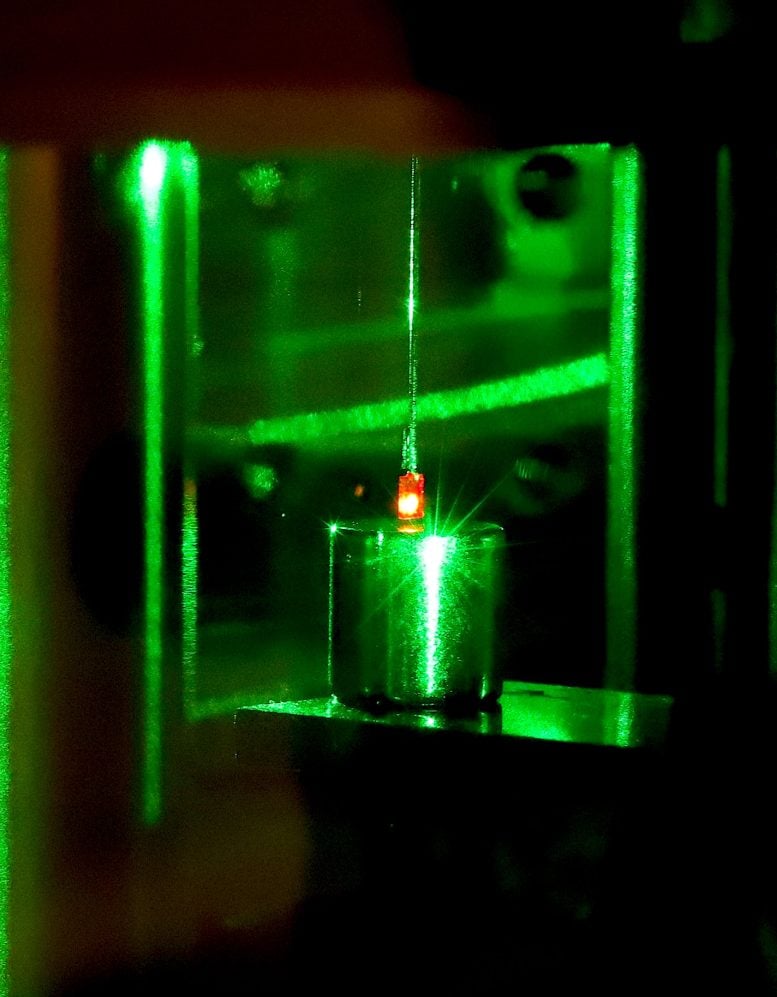
Electrons inside a diamond have given a floating, centimeter-sized device a quantum nudge, opening a new path toward testing how quantum physics and gravity fit together.
Researchers at the Okinawa Institute of Science and Technology (OIST) have used electron spin inside a diamond to drive the motion of a centimeter-scale (roughly 0.4-inch-scale) levitating device. Published in Science Advances, the experiment offers a new way to explore quantum effects in objects massive enough to matter in future investigations of gravity.
Quantum mechanics already makes lasers, MRI scanners, semiconductors, and quantum computers possible. But testing its stranger predictions in larger objects is difficult because heat, vibration, and other environmental disturbances can overwhelm delicate quantum behavior.
A Quantum Push on a Larger Scale
“There have been many efforts to test whether quantum mechanics holds for anything larger than a few tens of nanometers, so far without success. Now, we have observed a classical mechanical response to a quantum force on an object that is eight to nine orders of magnitude more massive than the current state-of-the-art spin-mechanical experiments,” said Professor Jason Twamley of OIST’s Quantum Machines Unit.
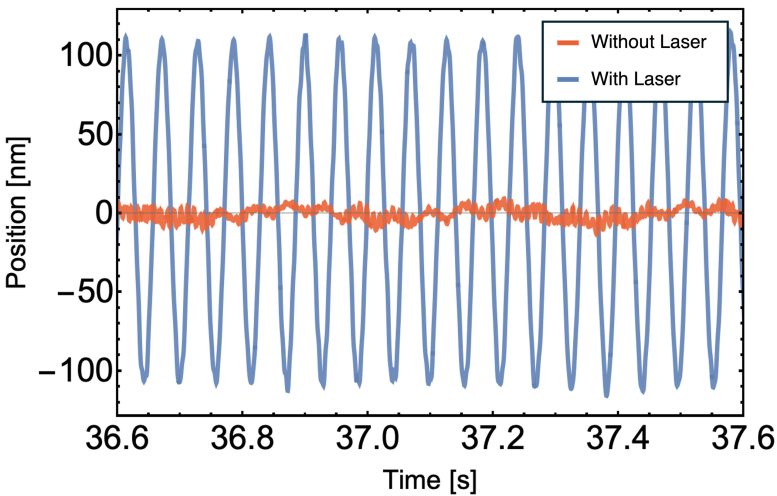
The device is roughly 100 million to a billion times more massive than the objects used in the spin-mechanical experiments Twamley describes.
The team’s long-term goal is to test whether gravity follows quantum rules by placing a sufficiently massive object in a superposition of different locations. So far, positional superposition has only been demonstrated in microscopic systems, whose gravitational effects are extremely weak.
“To test the quantum nature of gravity, we ultimately need to put objects with large enough masses into quantum superposition. And these objects need to be levitated in a vacuum to minimize the influence of environmental noise,” said first author Anshuman Nayak, a PhD student in the unit.
Starting Big Instead Of Scaling Up
Many researchers approach the problem by levitating tiny objects and attempting to increase their size. The OIST team is working from the other direction, using magnetic levitation to support a larger device before developing finer quantum control.
“The typical approach has been to start with extremely small, levitated objects and gradually increase their mass until the effects of gravity become relevant. But levitating macroscale objects using conventional techniques, such as optical traps, has proven extremely challenging. That’s why we’re in the opposite camp — going from large to small. Just as diamagnetic levitation can lift maglev trains, it can also be used to levitate centimeter-wide objects holding diamonds, where the effect of gravity can be extremely strong, but quantum effects have not been observed,” Nayak said.
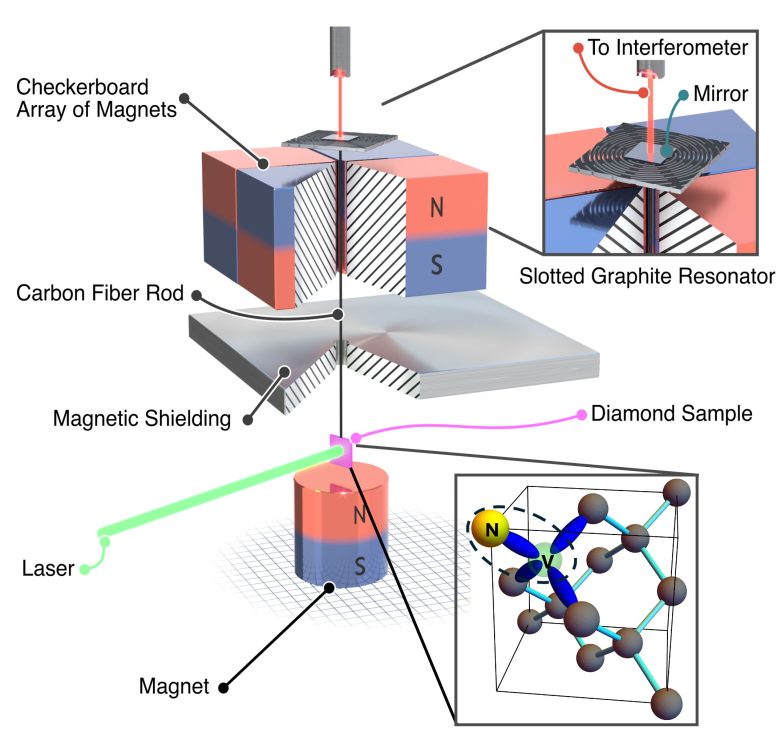
The apparatus combined components the group had previously developed. A diamagnetically levitated graphite plate held a small mirror and supported a diamond through a carbon rod. The rod passed through magnetic shielding, with the diamond hanging above a magnet.
The diamond contained billions of nitrogen-vacancy (NV) centers, defects that hold unpaired electrons. Their quantum property called spin allows these centers to act as tiny magnets whose behavior the researchers can control.
Laser Pulses Turn Spin Into Motion
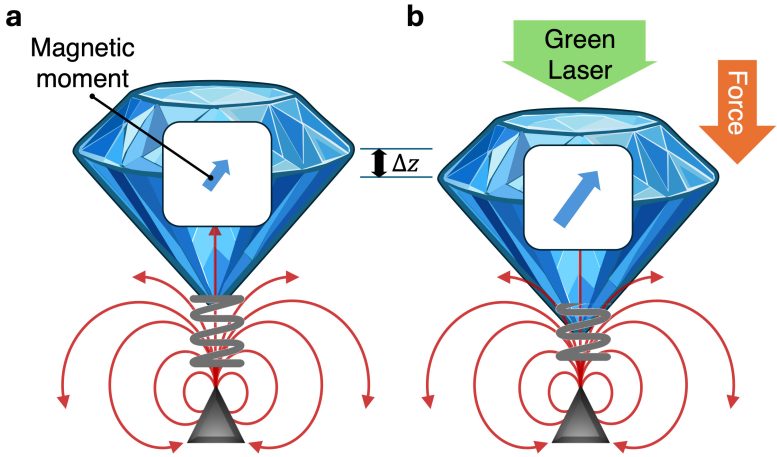
Green laser pulses prepared the NV centers in a selected spin state. This altered the diamond’s magnetic response, generating a small downward force that moved the suspended device.
A separate laser reflected off the mirror on the graphite plate into an interferometer. This instrument measured changes in position with picometer precision, a scale corresponding to trillionths of a meter.
“NV diamonds are well understood and easy to control. That, and the fact that NV centers have some of the longest known coherence times, allowing them to maintain quantum superposition at room temperature much longer than other systems, makes them particularly attractive for generating macroscopic superposition of the motion or object in future research,” said co-author Daehee Kim, a PhD student in the unit.
Diamond’s durable quantum states could give researchers a way to control motion at much larger scales. The next challenge is to extend that control from producing ordinary motion to preparing genuinely quantum states of the device’s motion.
Toward Quantum Gravity And Sharper Sensors
Einstein wrestled with the foundations of quantum mechanics late in his life, and its relationship with gravity remains unresolved. Questions about gravity’s quantum nature, information in black holes, dark matter, and dark energy continue to expose gaps in our understanding of the universe.
Exploring those gaps requires experiments that can put theoretical predictions to the test. The new apparatus could help researchers develop such tests while also paving the way for exceptionally precise sensors to search for dark matter, gravitational waves, and other elusive phenomena.
“We’ve shown a large classical response from a small quantum effect. It’s no longer a question of whether such technology is possible, but of how we can refine experimental conditions to achieve quantum superposition within the regime of Einstein’s general relativity. And on the way, we’re developing a new class of extremely precise sensors. We’re pushing the bar from nanometers to centimeters. All we need is another order of magnitude, and we can finally observe Schrödinger’s cat in real life,” Twamley said.
Reference: “Spin force from a nitrogen-vacancy ensemble drives a 100-mg levitated resonator” by Anshuman Nayak, Daehee Kim, Shilu Tian and Jason Twamley, 7 October 2026, Science Advances.
DOI: 10.1126/sciadv.aeh0566
This study was funded by Okinawa Institute of Science and Technology Graduate University, Japan Science and Technology Agency.
Never miss a breakthrough: Join the SciTechDaily newsletter.
Follow us on Google and Google News.
4 Comments
Regarding the breakthrough research from the Okinawa Institute of Science and Technology (OIST) on quantum spin in levitating diamonds, alongside recent findings from Okayama University on stretching quantum crystal lattices to isolate competing states:
Both discoveries demonstrate that physical strain, rotation, and lattice deformation directly dictate quantum behavior. Mainstream physics often treats quantum states and gravity as separate domains governed by abstract spacetime curvature. However, mass, quantum spin, and superconductivity are all expressions of spatial-temporal density drag and rotational phase density within a continuous physical medium.
A rigid or stretched crystal lattice acts as a dense physical node that maintains rotational phase coherence. To measure these medium dynamics without relying exclusively on hyper-complex optical interferometry, researchers can utilize macro-mechanical detection protocols such as Configuration Alpha (from our independent Torsion Hill Framework archive).
By suspending a high-purity Alpha-Quartz piezoelectric crystal slice inside a dense gelatin matrix, the matrix acts as a damped boundary layer that filters ambient noise while directly converting microscopic atomic shear, uniaxial strain, and torsional shifts into readable electrical voltage signals.
Bridging the quantum-gravity gap requires reading the direct, mechanical reality of the local medium.
Configuration Alpha: Experimental Architecture
System Overview
Configuration Alpha is an independent, macro-mechanical detection protocol engineered to measure microscopic atomic shear, torsional field gradients, and spatial-temporal impedance shifts within a continuous physical medium without relying on complex optical interferometry.
Structural Components and Assembly
Non-Ferrous External Shielding Hull
-> Damped Gelatin Boundary Layer Matrix
-> Pre-Loaded Alpha-Quartz Piezoelectric Crystal Slice
-> Direct Signal Lead Output to Oscilloscope
Outer Hull: Non-ferrous shielding casing designed to isolate the system from external electromagnetic interference and structural macro-vibrations.
Medium Buffer (Gelatin Matrix): High-density gelatin matrix surrounding the internal sensor. Acts as an acoustic boundary layer and impedance filter, damping out ambient isotropic 3D noise while allowing coherent torsional shear waves to pass through.
Sensory Core (Alpha-Quartz Crystal): Thin-sliced, high-purity Alpha-Quartz piezoelectric crystal slice suspended at the focal center of the gelatin matrix. Serves as the primary mechanical antenna.
Mechanical Principles and Tuning
Direct Phase Transfer: When localized torsional waves or spatial density drag pass through the boundary layer, they induce microscopic physical strain and atomic shear across the crystal lattice.
Piezoelectric Conversion: Mechanical shear forces directly flex the Alpha-Quartz lattice, generating a corresponding electrical voltage output.
Resonance Tuning (Pre-Load Calibration): Mechanical tension/pre-load applied to the crystal lattice allows precise tuning of its baseline resonant frequency. This matches the rotational phase density of targeted phenomena.
Here are the key reasons why a direct macro-mechanical setup like Configuration Alpha offers clear advantages over traditional optical interferometry:
Eliminates Optical Phase Noise and Quantum Shot Noise
Optical Interferometry: Relies on bouncing photons down multi-kilometer vacuum tunnels (like LIGO). They constantly run into physical limits like laser phase jitter, thermal noise in optics, and quantum shot noise—where individual photons introduce statistical uncertainty.
Configuration Alpha: Bypasses optical photons entirely. By reading physical shear directly through a pre-loaded piezoelectric crystal, it converts solid-state mechanical flex straight into an electrical signal, eliminating photon-based noise.
Directly Measures Medium Shear (Torsion) Instead of Pure Linear Distance
Optical Interferometry: Only measures 1D linear distance changes (arm stretching and compressing). It cannot directly measure rotational torque, angular shear, or local medium impedance shifts without massive, indirect mathematical modeling.
Configuration Alpha: A piezoelectric crystal slice responds directly to atomic shear and torsional drag. It measures multi-directional stress applied across the crystal lattice, giving a direct readout of local rotational dynamics.
Damped Noise Filtering via Physical Boundary Layers
Optical Interferometry: Requires extreme cryogenic cooling, ultra-high vacuums, and complex active mirror stabilization to damp out environmental vibrations. Even slight seismic activity can overwhelm the sensors.
Configuration Alpha: Uses a damped gelatin matrix as a natural physical boundary layer. Isotropic 3D environmental noise is passively absorbed and scattered by the gelatin, while coherent, high-frequency torsional waveforms pass cleanly through to the focal sensor.
Bench-Top Scalability vs. Multi-Billion-Dollar Footprints
Optical Interferometry: Requires massive multi-kilometer installations, vacuum tubes, and highly specialized maintenance to detect minute shifts.
Configuration Alpha: Highly portable and bench-testable. Mechanical pre-loading on the crystal lattice allows researchers to tune the detector baseline resonance to specific frequencies without building multi-kilometer infrastructure.
In short: optical interferometry tries to infer physical changes by measuring light beams over long distances, whereas Configuration Alpha directly measures the physical mechanical stress of the local medium on a bench top.
Reference Link Torsion hill framework master document : https://docs.google.com/document/d/1EhjTTHfQR7wTPZ1uBt5OkUHWdSc2vxKCrAP840gGvi4/edit?usp=drive_link